


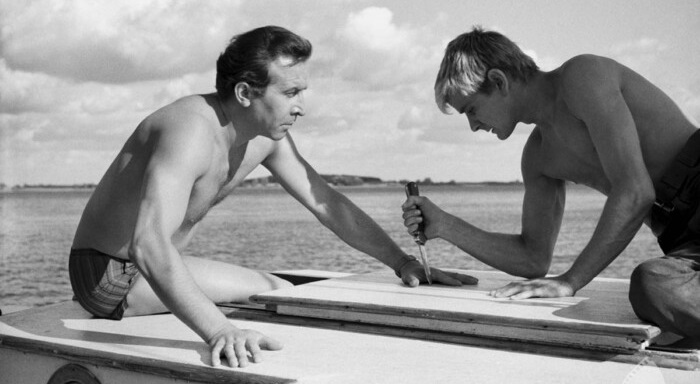
The Polish-French filmmaker Roman Polanski (Paris, 1933), a highly controversial figure privately—having been a fugitive from U.S. justice for nearly half a century due to the rape of a minor, and a person whose name is linked to several other potential cases of sexual violence—is among the most talented film creators of the second half of the 20th and the beginning of the 21st century. He mastered his film craft in Poland, where he shot several short feature films (Two Men and a Wardrobe, 1958) and his feature-length debut Knife in the Water (1962). In Great Britain, he filmed the notable thriller Cul-de-sac (1966), which allowed him to launch a controversial Hollywood career (Rosemary’s Baby, 1968; Chinatown, 1974). Following a sexual scandal and his flight to France, he directed several film hits (Tess, 1979; The Pianist, 2002).


His feature debut, Knife in the Water (Nóż w wodzie), is a special film, both due to its theme and the manner in which it was filmed. It is a true psychological drama between three people in a cramped space—a yacht. The characters (without a single supporting actor or extra) are:
-
A middle-aged gentleman, educated, refined, eloquent, impeccably dressed; the owner of a luxury car and a fully equipped yacht for recreational sailing (played by Leon Niemczyk).
-
A wife at least 15 years younger, mostly passive in demeanor; a poor student before her marriage (played by Jolanta Umecka).
-
A hitchhiker—a silent young man of unknown name, origin, and occupation; for unclear reasons, he never separates from his switchblade (played by Zygmunt Malanowicz).
The married couple drives their luxury car to a lake, where they plan to spend the weekend sailing their own yacht. A tense atmosphere, a long monologue by the husband that cannot be heard but is visible through the windshield. Dissatisfied with his wife’s driving, the husband takes the wheel and—nearly hits a man standing in the middle of the road, attempting to stop the car. It was the hitchhiker. After a brief argument, the husband lets the hitchhiker in. The lake. The yacht. The hitchhiker intends to go his own way, but the husband invites him to join them for a sail. The young man hesitates but eventually agrees.


Sailing on a deserted lake. Alternations of wind gusts and silence. A scorching sun. With every gesture, the husband emphasizes that he is on his own turf, that he is the dominant figure. He is an experienced sailor, he is the captain here, and the hitchhiker, for whom sailing is unfamiliar territory, must obey commands. The young man accepts a subordinate position in the game that has begun. The wife observes them carefully.


Tension rises. A showdown between two men. The young man disappears into the waves. A search for him. An eruption of long-accumulated anger bursts from the wife. The husband, faced with the realization that he is a murderer, jumps into the water and swims toward the shore. He says he will bravely report the case to the police. The young man appears, having watched the entire scene from the water while hiding behind a nearby buoy. He enters the sailboat. The young man and the woman are completely alone.


The woman leaves the young man on an undeveloped part of the shore without looking back and continues to sail to the pier. Her freezing husband, in swimming trunks, is waiting for her.


The couple is back in the luxury car. The husband tries to maintain control over the situation and a semblance of superiority. The woman convinces him that the young man is alive, that she was with him. He, however, is convinced she is lying. He believes that by wanting to dissuade him from reporting the case to the police, she actually wants to portray him as a coward.


An intersection. One way leads to the city, the other to the police station. Will he report to the police?! Will he not report to the police?! The wife’s gaze is full of contempt. The car does not move. It stands still.
Polish cinematography is among the highest quality and most respected national cinemas. Its rise can be traced from the mid-1950s, when a wave of student and civil protests hit the “people’s democracy,” spurred by the initiated process of de-Stalinization. The temporary abandonment of rigid party control over artistic creation allowed a group of young filmmakers to develop what we call the Polish Film School. Among them, the leading creators were Andrzej Munk (Eroica, 1957) and Andrzej Wajda (Ashes and Diamonds, 1958), who depicted the bitter experience of Poles in World War II free from (mandatory) ideological constraints. At the beginning of the 1960s, they were joined by a slightly younger colleague who stepped even further, filming a movie that had nothing to do with war themes, universal enough to apply to Poland but also to any other nation/state in the world. It was Roman Polanski and his Knife in the Water.

Before us is a first-rate psychological study of the phenomenon of power and submission. Two men and a woman are in the cramped space of a sailboat. The older man is active, dominant, passive-aggressive in imposing his authority. The younger man is on unfamiliar ground, in a completely subordinate role, but accepts the challenge. The woman has previously been in a subordinate position, passive, but at the crucial moment, when the husband pushes the young man and he disappears into the waves, she becomes the dominant figure. She is the master of the situation during the young man’s second stay on the yacht (who did not earn his return by defeating his opponent, but by his opponent’s sudden flight) and remains so until the end, this time over her dethroned husband-master.


The circumstance that the film’s action takes place mostly on a vessel some five to six meters long, in the middle of a lake, presented a serious challenge for the young Roman Polanski. He solved the task he set for himself by choosing unusual and very expressive camera angles, alternating numerous deep shots in which the three characters constantly change their arrangement, and a wise application of light, especially in the scenes taking place in the yacht’s cabin. A great contribution to the atmosphere and quality of the film is also made by the music, composed by the famous Polish jazz musician Krzysztof Komeda, a constant collaborator of Polanski until his death in 1969.


Knife in the Water does not deal with a theme from Polish history or the contemporary era; rather, it analyzes universal interpersonal relationships. The character of the young hitchhiker is nameless, as is the lake where the drama unfolds. Although the married partners bear typical Polish names—Andrzej and Krystyna—and the dialogues are in Polish, the depicted psychological game could take place anywhere, in any era, in any language. Regardless of its universality, the film is still a reflection of the atmosphere in Poland during the temporary easing of party constraints, following the reading of Nikita Khrushchev’s “Secret Speech” at the 20th Congress of the Communist Party of the USSR in 1956 and the death of Poland’s Stalinist leader Bolesław Bierut in Moscow the same year under unexplained circumstances. The new-old leader of the Polish party and state, Władysław Gomułka, had to give in, pressed by a wave of massive civil protests. The conflict between the husband and the young hitchhiker can be viewed in this key, where the former represents the authoritarian power of the ossified party bureaucracy, and the latter the cry of youth for freedom and democracy. That is why Knife in the Water immediately gained cult status among young Poles.
Written by Ivan Hofman