Thomas Mann – Death in Venice: The Path to the Abyss. “Death in Venice” is not merely a novella about decadence and longing, but a profound philosophical study of the conflict between Apollonian moderation and Dionysian chaos. Through the fate of Gustav von Aschenbach, Mann explores the boundaries of artistic creation, the nature of beauty, and the inevitable descent into the abyss of the irrational, shaded by the cholera devouring Venice. In this analysis, we decipher the symbols of Mann’s masterpiece and explain why Aschenbach’s journey remains one of the most fascinating trajectories in world literature.
One of the most significant German writers, Thomas Mann—creator of the epic novel Buddenbrooks (1901), for which he received the Nobel Prize in Literature in 1929, and a fierce opponent of the rising Nazi Germany during the creation of his most vital works (The Magic Mountain, Lotte in Weimar, Doctor Faustus)—deals with one of his eternal themes in the novella Death in Venice (1912): the life of the artist. In a city of somber atmosphere, a city doomed to ruin and the plague of cholera, Venice, the fatal encounter between the writer Aschenbach and the boy Tadzio from a Polish family takes place. The writer, consumed by the boy’s ethereal beauty—an aesthetic experience that transforms from the aesthetic to the erotic—finds death in a city ruled by a contagious disease. Enslaved by conventional morality, he perceives his own death as the only solution that saves him from the humiliation he would suffer due to the sincerity of his feelings toward the boy within a society where falsehood reigns as a fundamental principle.
Death, which finds him in a city surrounded by contagion, is a resolution for him; it rescues him from the humiliation his sincere emotions would provoke in a society dictated by lies.
Thomas Mann wrote in the 20th century, a time of numerous revolutions and innovations in art. During the first twenty years of that century, avant-garde, radical artistic movements emerged, foremost among them Dadaism and Surrealism. Through their manifests, the avant-garde advocated for new forms in painting and sculpture aligned with the new era, responding to a new way of perceiving reality, the feeling of life, and the imagination of the future. Cubism, Futurism, Expressionism, and Surrealism appeared. It was a century of experiments where artists conducted one trial after another, where currents and tendencies developed from one another or quickly dissolved. The 20th century was also marked by inventions and innovations, characterized by technical progress and growing urbanization. The function of literature changed at the beginning of the century; writers began to write about their feelings and internal states. Writers became increasingly subjective, less interested in objective reality, turning inward toward their own interiority.
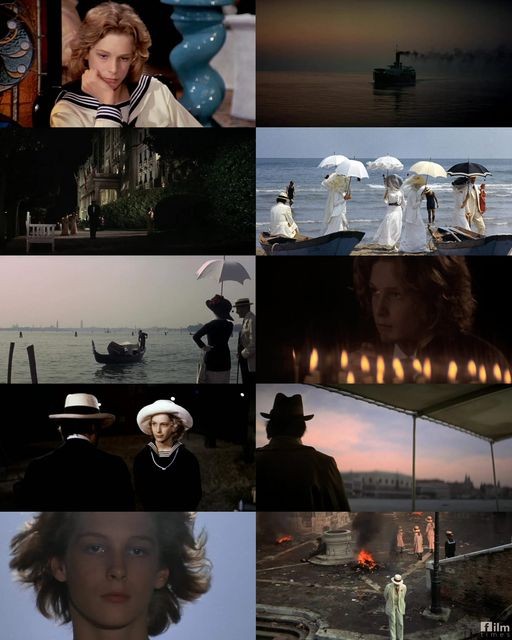
In the novella Death in Venice, the main character is the writer Gustav Aschenbach (a widower in his fifties, presented as a man who does not know life, a man who lived by Apollonian principles, considering art a cold, rigid, and passionate duty rather than a Dionysian passion, inspiration, or a wild living of the moment transposed by strong emotion into a work of art). He leaves Munich for Venice for a holiday. On this unusual journey, Aschenbach is followed by a series of miraculous circumstances and grotesque companions; Eros invokes Thanatos, Venice invokes Death. Aschenbach arrives in Venice on a boat black as a coffin and stays at a hotel where a Polish boy also spends his time, capturing Gustav’s interest.
Decadent Venice in 1912: morbid charm, global bourgeoisie, a luxury hotel on the Lido, street musicians who—despite the ban—wish to receive a handful of lire and entertain wealthy guests, or mock them in the end. Thomas Mann describes the ascetic life of Gustav von Aschenbach, who in his loneliness and dedication eventually encounters the boy Tadzio as the incarnation of perfect beauty. He justifies his fascination through philosophical arguments, echoing the Platonic dialogue between Socrates and Phaedrus, asserting that beauty is the only form of the spiritual that we can accept through our senses. Aschenbach convinces himself that his interest in the boy is aesthetic. Gustav watches where the boy is, how he is dressed, and describes his body and movements while bathing. Over time, Gustav can no longer restrain himself and becomes obsessed. His love for the boy is Platonic. His health deteriorates, and he eventually dies in a chair while watching the boy play on the beach.
Thomas Mann skillfully places the conflict between the artist, the individual, and the banality of society and its limiting conventions into his own philosophical focus (under the unquestionable influence of the then-dominant German philosopher Friedrich Nietzsche and his theory of Apollonian and Dionysian art). Mann uses dialogues and describes the places the characters visit, especially Venice, creating a somber and mystical atmosphere. Although he describes the environment, he prioritizes the characters’ impressions and thoughts. In Death in Venice, the main character Gustav von Aschenbach is an artist who understands art in a Nietzschean sense as a higher level of life that brings him happiness.
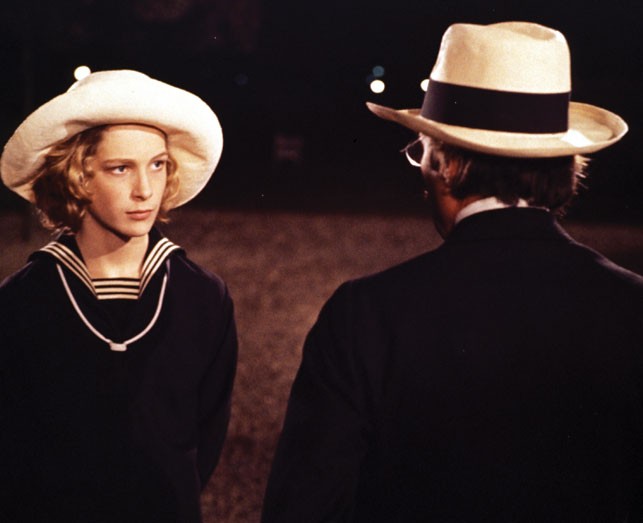
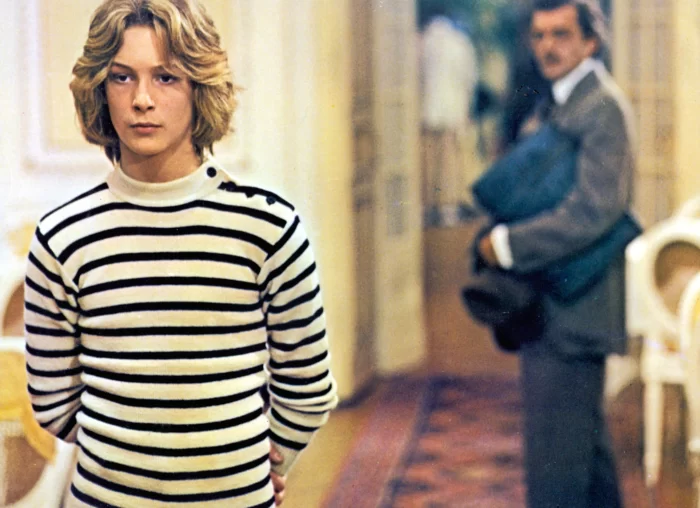
Gustav feels lonely and says that in solitude, something original and beautiful is born: a poem. “In solitude, on the contrary, something opposite matures, something disproportionate, absurd, and forbidden.” In his hotel, a Polish family is staying, including the boy Tadzio, who is about fourteen. Gustav observes him and finds his facial features exceptionally beautiful. The next morning, he sees the boy’s sisters at breakfast, but the boy is absent; Aschenbach concludes he is privileged and can sleep as long as he wishes. Eventually, he sees Tadzio and is stunned by his beauty, thinking of him constantly. He elevates the boy to divine heights, as his beauty can only be measured against the divine. The fourteen-year-old plays with other children on the beach, and Aschenbach listens intently to discover more about him, watching him bathe and dive.
“He returned, running through the sea, and the foamy water splashed as he threw his head back; and to watch that living figure, full of early masculine grace and austerity, with wet hair and beautiful like a tender god, coming from the depths of the sky and sea, emerging from the element and escaping it—that sight resembled mythic representations, like a poet’s revelation of ancient times, the origin of form, and the birth of gods.”
Gustav then decides to walk through the Venetian streets. However, the walk is not relaxing; the crowds are immense and the air is heavy and thick. Drenched in unbearable sweat, he flees the crowd into the poorer districts. He sits, wiping his sweat, and decides that the environment does not suit him and he must leave. Moments after making the decision, he regrets it. He sees Tadzio (within the novella’s mythological symbolism, the boy represents the symbolic figure of the divine Dionysus to the artist Aschenbach) and realizes the boy is the reason he does not want to go. He understands how difficult it is to be in Venice and that it harms his health, but he feels the need to be near the boy and gaze at his beauty. This summer in Venice is different. “But this summer enchanted him, numbed his will, made him happy.”
Aschenbach feels something for the boy he has never felt before. He is obsessed and wants to be near him. He feels exhilaration every time he sees him; every encounter and glance represents the highlight of his day. This is a completely new feeling for him (a wondrous Dionysian, Nietzschean symbolic aspect) and the boy attracts him immensely:
“His honey-colored hair wound in curls around his temples and neck, the sun shone upon the down on the upper part of his spine, the fine drawing of the ribs, the harmonious structure of the chest, all highlighted through the clinging fabric; the armpit was clean as a statue’s, the lower legs shone, covered with blue veins; it seemed his body was made of light material. His spirit strained, his education was stirred, his memory cast ancient thoughts into the light of day, thoughts he had received in his youth and never revived with his own fire.”
Every day, Aschenbach looked for the boy. He maintained the expression of an educated and composed man to avoid betraying his inner excitement. On one occasion, Aschenbach failed to set a serious expression, and Tadzio smiled at him; Gustav was deeply distracted, finally realizing that he loved him. He compares the boy to Narcissus because of his beauty. To him, the boy is so beautiful and perfect like Narcissus. Just as Narcissus was enthralled by himself, caring for no one, Gustav is enthralled by the boy to the point of not noticing others in the hotel.
However, over time, Gustav notices unpleasant things. He realizes that despite it being summer, there are fewer guests. Once, he hears a conversation between a gentleman and a local barber about the disease ravaging the city. Something was strange about it. Thomas Mann describes the state of the city and Aschenbach’s psyche simultaneously, so the city represents the state of his soul. The disease is actually the sickness of his soul because he is increasingly obsessed with the boy. As time passes, Aschenbach is no longer satisfied with chance encounters; he follows and stalks him: “His head and heart were full of intoxication, and his steps followed the commands of a demon who took joy in trampling the reason and dignity of men.” Once, he stood before the boy’s room door, leaning his forehead against the handle for a long time, unwilling to pull away. He risked being caught, but it no longer mattered. Only being near the boy and watching him was essential.
Gustav then dreams of a mountain region:
“And in the stubborn light, from the wooded heights, between trees and mossy rocks, it crashed and rolled: they were people, animals, a swarm, a frenzied pack; it all flooded the clearing with bodies, flame, turmoil, and a drunken dance.” In the dream, within a Dionysian, debauched atmosphere, women beat drums, groan, wave swords, and hold snakes. A flute’s sound lures above the noise. Gustav realizes it beckons him, but he feels fear and disgust at the same time: “With the drums, his heart also beat, his head spun, fury seized him, blindness, blind lechery, and his soul yearned to join that divine circle.”
After that dream, Aschenbach no longer cared if he was caught watching the boy.
“The power of fascination is such that Aschenbach is unaware of all the consequences of his state. He gradually becomes a slave to the boy’s beauty.”
Thomas Mann no longer calls him by name but refers to him as “the infatuated” or “the lover” because he was no longer the Gustav from the beginning of the holiday. Aschenbach often visited the hotel barber, wanting to rejuvenate himself; he changed his appearance and hair color. He wanted to look younger and more alluring, perhaps to be noticed by the boy or to hide his age so his feelings would seem more appropriate. “A sixty-year-old man, allowing himself to be cosmetically rejuvenated to look more attractive, is a figure of wretched, pitiful deception.” As the boy went into the city with his family, Gustav followed, keeping his distance so as not to be noticed. Tadzio turned several times as if checking if his lover was still following. He saw him but did not betray him.
“Such knowledge brought the lover to intoxication; the boy’s eyes beckoned him, and crazed with passion, he crept forward.”
In the end, fatigue and exhaustion overcome him. Gustav is spent and does not feel well. He watches the boy play with friends for the last time. Tadzio wrestles with a stronger boy who pushes his head into the sand; it seems Tadzio might suffocate. The fight stops. Tadzio continues further. “And the enchanted spectator sat there, as he had once sat when for the first time, sent from that threshold, that twilight gaze met his.”
Aschenbach slumped and nearly fell from his chair. People came to help and carried him to his room. That same day, Gustav Aschenbach died.
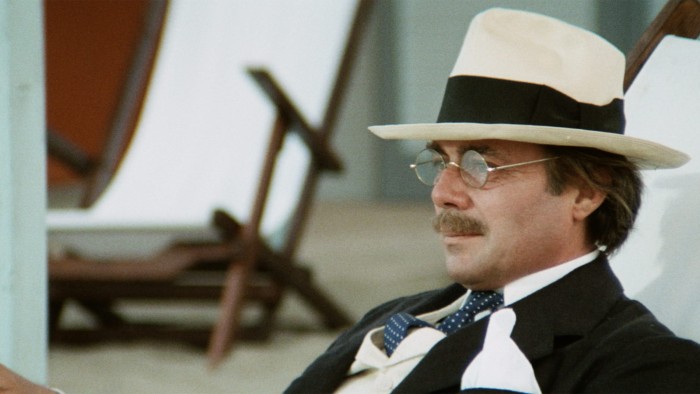
Thomas Mann’s most significant works spoke precisely of the mutual relationship between life and art. “For insofar as true, honest artists became more isolated in bourgeois society, they experienced more deeply the real, personal, human problems arising from this solitude.” Thomas Mann’s novella Death in Venice is a complex work full of deep symbolic and allegorical meanings, created on the eve of World War I—a picture of the decadence of a faltering bourgeois society vanishing in its own lies, lack of morality, hypocrisy, and perversions. The cholera epidemic in Venice, where Aschenbach seeks peace, is perceived as a punishment for the disregard of moral and cultural values, symbolically represented through the sickness of Aschenbach’s lust. Every image seems to have a dual nature: it can be perceived realistically and allegorically.
Author: Dragan Uzelac

Thomas Mann – Death in Venice: The Path to the Abyss added by Dragan Uzelac on
View all posts by Dragan Uzelac →
You must be logged in to post a comment Login